

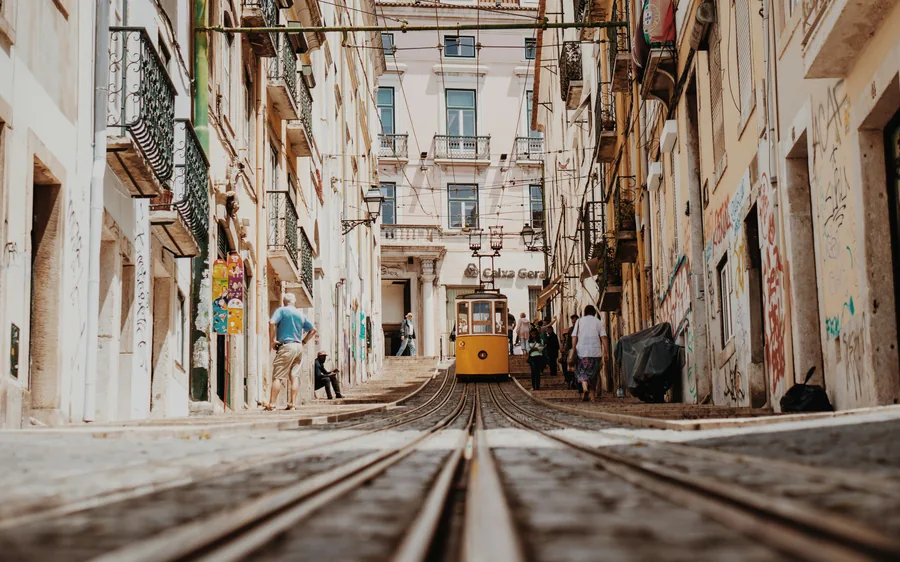
In June Lisbon moves outdoors. The city leaves the house and spends a month in the street, peaking on the night of the 12th into the 13th, the eve of Saint Anthony. It is the night when the marches, the weddings and the street parties all fall together.
13 June
It is Lisbon's municipal holiday. Saint Anthony was born in the city around 1195 and died in Padua on 13 June 1231.
He was canonised on 30 May 1232, eleven months after his death, in the cathedral of Spoleto, by Pope Gregory IX. It is the second fastest canonisation in the history of the Church. He remains Lisbon's principal patron saint.
The marches began in a cinema
There had been marches in Lisbon since the eighteenth century, but the competition dates from 1932.
The first was held on the night of 12 June 1932, at the Capitólio cinema in Parque Mayer, organised by José Leitão de Barros, editor of Notícias Ilustrado, with support from Norberto de Araújo and Diário de Lisboa. Campo de Ourique won, followed by Bairro Alto and Alto do Pina.
A second event followed two weeks later, on the eve of Saint Peter. Across the two nights of 1932, six neighbourhoods competed: Campo de Ourique, Bairro Alto, Alto do Pina, Madragoa, Alfama and Alcântara.
The city council took the marches in hand in 1934. In 1952 they began coming down Avenida da Liberdade, where they still are.
Under the Estado Novo there were interruptions, tied to the Spanish Civil War, the Second World War and the post-war crisis. In forty-two years there were eighteen editions. The regular annual parade only resumed in 1988.
Today EGEAC organises it and twenty marches compete, alongside children's and non-competing ones.
The weddings
They joined the marches in 1958, proposed by the journalist Augusto Pinto and organised and funded by the newspaper Diário Popular. The first edition married thirty-six couples.
They were interrupted after 1974 and resumed in 2004 by the city council. They take place on 12 June, with a civil ceremony at the city hall and a religious one at the cathedral.
Where fado comes in
No study links the two genres, and there is no point inventing one. What exists are three coincidences that say enough.
The first is geographical. Alfama, Bairro Alto, Madragoa and Mouraria are at once the fado neighbourhoods and the marching neighbourhoods, and have been since 1932. Same streets, same people.
The second is chronological. The institutionalisation of the marches, between 1932 and 1934, is contemporary with the spread of fado houses in Bairro Alto and the professionalisation of the singers.
The third has a name. Alfredo Marceneiro, the greatest composer of traditional fados of the twentieth century, wrote the Marcha do Alfredo Marceneiro. The Fado Museum lists it among his compositions, alongside Fado Cravo and Fado Bailado.
The people singing fado in the neighbourhood fado houses were writing marches for the neighbourhood to take to the street. They were not separate worlds.
The sardine
The sardine entered the festivals for an unromantic reason: in June it was plentiful and it was cheap.
The season runs from June to October. The fattest sardine is the one at the end of the season, in September and October, once the fish has had time to build reserves before the winter spawning, which runs from October to April and peaks between December and February. The June sardine is the one people eat, not the one with the most fat.
The fishery is managed jointly by Portugal and Spain, with a maximum of one hundred and eighty days per vessel per year, no fishing at weekends, seasonal closures between December and April, and a minimum landing size of eleven centimetres.
It is eaten on a slice of bread, which serves as the plate and absorbs the fat. The practice is standard at the street parties, though the origin of the custom is not documented.
What changes in Alfama
Alfama has competed in the marches since 1932 and is one of the most sought-after party neighbourhoods in the city. During the festivals the narrow streets fill up and the tables come outdoors.
The programme changes from year to year and EGEAC publishes it. Our Alfama house is on Travessa do Almargem, inside the neighbourhood, and Chiado is fifteen minutes' walk away. There is fado in both every night, June included. Tables can be booked here.