

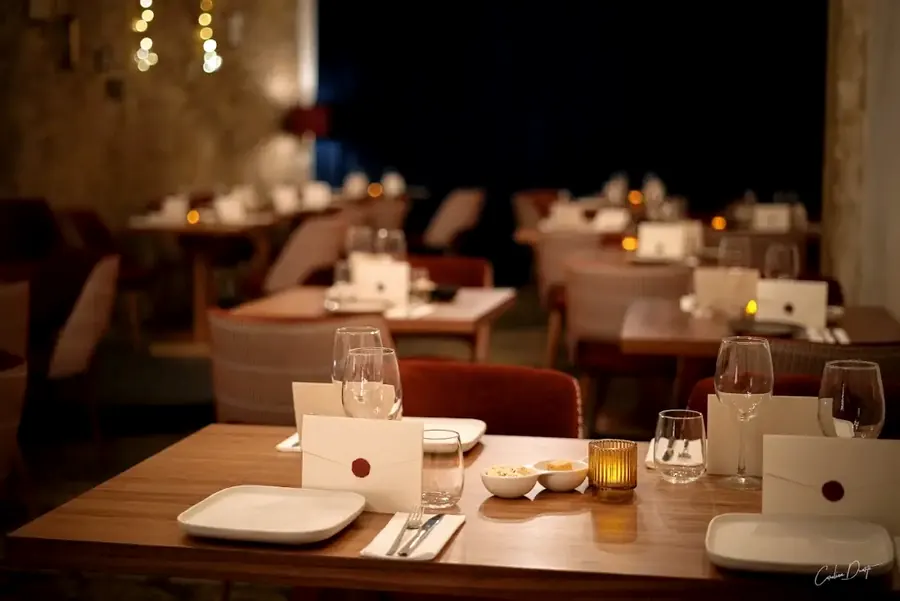
There is no Coca-Cola at Fado ao Carmo. No foreign soft drink, no foreign beer, no Scotch. The house rule is easy to say and hard to keep: everything served has to be Portuguese and made in Portugal.
The rule
It covers the whole list. Food, wine, spirits, soft drinks, coffee.
The whisky is the part that surprises people who ask. Portugal makes whisky: Venakki Distillery, in Alpiarça, in the Ribatejo, has been distilling since 2012 and put its first bottle on the market in 2020. That is the one behind the bar.
The rule is not a talking point. It only shows when somebody orders something that is not there.
Eleven regions and Bucelas
Portugal has fourteen wine regions, according to the Instituto da Vinha e do Vinho: Vinho Verde, Douro, Trás-os-Montes, Távora-Varosa, Dão, Bairrada, Beira Interior, Lisboa, Tejo, Península de Setúbal, Alentejo, Algarve, Madeira and the Azores.
Our list carries wines from eleven of those fourteen, plus Bucelas, a denomination inside the Lisboa region that appears under its own name. More than eighty references, all Portuguese, and so are the grapes. The Instituto da Vinha e do Vinho counts around 250 native varieties in Portugal, one of the largest varietal inheritances in the world. A list made only of Portuguese grapes is not a restriction. It is a choice among 250.
Bucelas has been a demarcated region since 1911 and sits twenty kilometres from the door. The denomination requires Arinto. It is the white wine Lisbon drank for centuries without naming it.
The Douro is another matter. The region was created on 10 September 1756, with the Companhia Geral da Agricultura das Vinhas do Alto Douro, and marked out on the ground between 1758 and 1761 with 335 granite posts. Wine boundaries had been drawn before, in Chianti and in Tokaj. What began in the Douro was the whole apparatus: a delimited area, production rules, quality classification and inspection.
The kitchen reads like a map
Chef António Saraiva's dishes come from places you can point to.
Kid goat the Minho way. Fried cuttlefish the Setúbal way. The Alentejo chickpea stew, which Portugal's Directorate-General for Agriculture and Rural Development lists as a traditional Portuguese product, with the note that the tradition comes from labourers who slept out in the fields and carried clay pots with them.
The black pork on the boards is the Alentejana breed, and the legal designation is Carne de Porco Alentejano DOP: animals slaughtered between eight and fourteen months, across an area of more than 26,000 square kilometres between Évora, Beja, Portalegre and Setúbal.
Alheira comes from Trás-os-Montes. The story everyone tells, of a pork-free sausage invented by converted Jews to mislead the Inquisition, is firm tradition with no contemporary documents behind it. What is documented is the product: Alheira de Mirandela IGP, Alheira de Barroso-Montalegre IGP.
And the Abade de Priscos pudding, from Braga, has pork fat in the caramel. Manuel Joaquim Machado Rebelo was parish priest of Priscos from 1883 and for the following forty-seven years, and is one of the great Portuguese cooks of the nineteenth century. He left few written recipes. This is one of them.
About the Coca-Cola
There is a detail worth having, because almost everybody tells it backwards.
Coca-Cola was off the Portuguese market from 1927 to 1977, fifty years. Salazar did not ban it: in 1927 he was not yet a minister. It was Ricardo Jorge, then the head of public health, who ordered the product seized, on the argument of the cocaine in the formula, which was only removed in 1929. The Estado Novo kept the ban in place, by then for protectionist reasons, and Coca-Cola only entered Portugal legally on 4 July 1977.
The slogan primeiro estranha-se, depois entranha-se, attributed to Fernando Pessoa, is the other half of the same story, and the documentation behind it is late and thin.
So no, the absence of Coca-Cola from this fado house does not come from that. It is a choice made by the people who write the menu.
Why this matters to the fado
Fado has been inscribed by UNESCO as intangible cultural heritage of humanity since 2011. The inscription says nothing about cooking. It describes a practice passed on inside a place, among people who share it.
A fado house is one of those places. The list is part of what gets passed on.
The menus are here and tables can be booked here.