

People who have never been to a fado house usually arrive with an unasked question: what is and is not allowed. The short answer is that one rule belongs to the tradition and several belong to each house. Both are below, and so is how it works here.
The one rule that really belongs to fado
You stay quiet while anyone is singing. It is the norm across every fado house in Lisbon and the only one that is not negotiable.
It is not etiquette for its own sake. Fado is made with one voice, a viola and a Portuguese guitar, without heavy amplification. A conversation half a dozen tables away is audible on the floor and covers the guitar, the most fragile instrument in the room. One person talking ruins the fado for the whole room.
The phrase that opens the night, silêncio que se vai cantar o fado, has no known author and no date. It stayed through use.
How it works at Fado ao Carmo
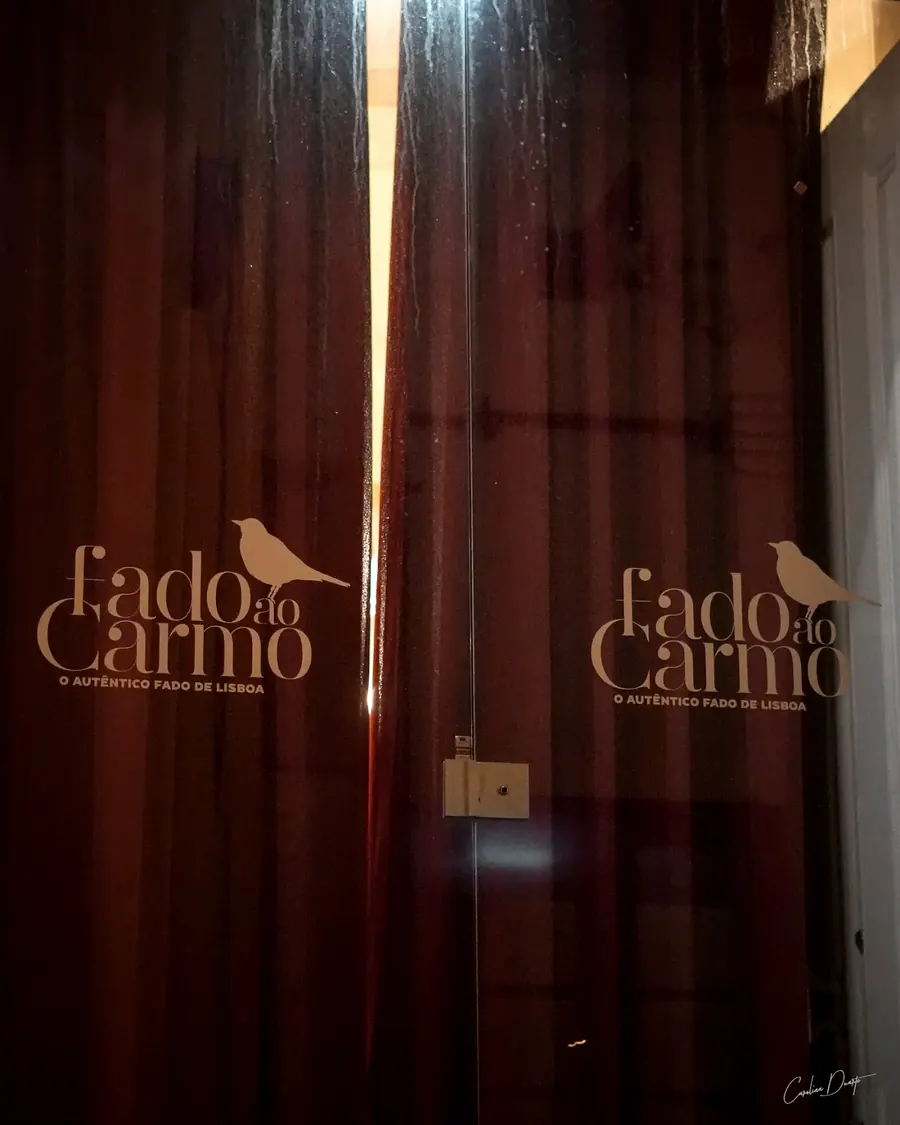
When the fado is about to start, we bring the lights down, close the doors and draw the curtains.
Service stops. No plates come in or go out, nobody crosses the room, nobody walks in front of the person singing. Everything stays still until the end of the set.
Then the lights come back, food is served, people talk. Later it closes again.
We do it this way out of respect for fado and for the people who sing and play it. It is also what lets you hear a Portuguese guitar without amplification, which is how it was built to be heard.
You can record on your phone. We only ask for the sound off and the flash off.
None of this needs learning in advance. When the night starts, it explains itself.
When to clap
At the end of each fado, not during it.
And no clapping along to the beat, unlike almost every other kind of Portuguese popular music. Marking the rhythm with your hands pulls the players out of line and forces the singer to work against the room.
A fadista usually sings three or four fados in a row and then leaves the floor. The long applause belongs at the end of that set.
Singing along, no
Even if you know the words. Unless the fadista expressly invites it, which happens rarely and always on their initiative.
There is one place where the rule is different: fado vadio, amateur fado. There is no billing and no contract, and whoever sings invites themselves, with no agreed repertoire. It happens in taverns and neighbourhood clubs, above all in Mouraria and Alfama, and it is a different environment from a fado house.
Photographs and phones
Here there is no tradition to invoke. No norm of fado covers this, not at the Fado Museum and not in the UNESCO inscription. What exists is each house's policy, and it varies.
The common minimum is flash off and sound off. A flash blinds someone singing three metres away. A phone ringing mid-fado is audible across the whole room, for the same acoustic reason that requires the silence.
If in doubt, ask the house when you sit down. Nobody minds.
What to wear
There is no code. Fado houses were born in taverns and in houses of poor reputation in the neighbourhoods by the river, and they were never places of etiquette.
The black you see on the floor is another matter. The black dress and shawl worn by fadistas are usually explained as mourning for Severa, who died in 1846. No source supports that. The Fado Museum credits the convention to Amália Rodrigues, who established the systematic use of black and of the shawl, and the habit of standing in front of the guitarists. It is a twentieth-century stage decision.
What time to arrive
You eat first and listen afterwards. Arriving on top of the fado means eating in a hurry or eating afterwards.
In our fado houses the fado starts at 20:30 in Chiado and at 21:00 in Alfama. An hour before is a comfortable margin.
How long it lasts
A fado night is not a concert with a fixed finishing time. Singers alternate, there are pauses between sets, and the room falls into silence and comes back out of it several times.
Chiado closes at 01:00 and Alfama at 02:00. Nobody is pushed towards the door.
You do not need to understand it
Neither the words nor the language. The UNESCO inscription describes fado as a multicultural synthesis, with roots in Afro-Brazilian sung dances, local genres and rural traditions brought to Lisbon by internal migration. It is music made of several things at once, and it is heard before it is understood.
Tables can be booked here.