Artists
To hear at Fado ao Carmo Alfama
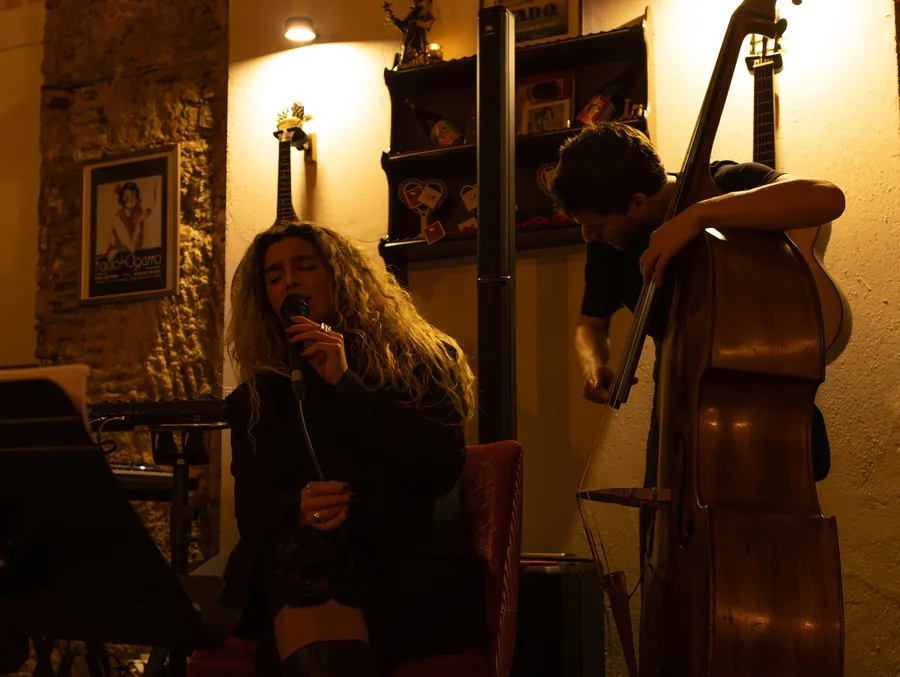
Every night there are two voices, a Portuguese guitar and a viola. Pick a day to see who sings and plays that night. Tap an artist to find out more.
Monday
Tuesday
Wednesday
Thursday
Friday
Saturday
Sunday
BF Beatriz Felício
Fadista
Rodrigo Costa Félix
Fadista
Luís Guerreiro
Portuguese guitar
CP Carlos Manuel Proença
Viola
FV Filipa Vieira
Fadista
Rodrigo Costa Félix
Fadista
Luís Guerreiro
Portuguese guitar
João Domingos
Viola
AM Ana Margarida
Fadista
Rodrigo Costa Félix
Fadista
Luís Guerreiro
Portuguese guitar
JF João Filipe
Viola
Matilde Cid
Fadista
Rodrigo Costa Félix
Fadista
Luís Guerreiro
Portuguese guitar
Bernardo Saldanha
Viola
Sofia Ramos
Fadista
José Geadas
Fadista
Luís Guerreiro
Portuguese guitar
PS Pedro Saltão
Viola
Diana Vilarinho
Fadista
Francisco Moreira
Fadista
Luís Guerreiro
Portuguese guitar
Luís Pontes
Viola
Ana Rita Prada
Fadista
Rodrigo Costa Félix
Fadista
Luís Guerreiro
Portuguese guitar
André Ramos
Viola
(The line-up may change without prior notice.)
×
BF Beatriz Felício
Fadista
Days at Fado ao Carmo Alfama Monday
×
Rodrigo Costa Félix
Fadista
Rodrigo Costa Félix is one of the leading names in fado of his generation. A professional for more than 30 years, his stage presence stands out for its elegance, restraint and maturity.
Highlights of his career include performances on the most important Portuguese stages, tours and concerts in dozens of countries; guitarist Mário Pacheco’s concert at the Palace of Queluz (2005), alongside Mariza, Camané and Ana Sofia Varela, recorded on CD/DVD and named one of the best of the year by Songlines magazine; highly successful US tours in 2013 and 2014; appearances at the biggest fado festivals in Portugal and abroad; the Amália Rodrigues Foundation award for best fado album of 2012, for Fados de Amor; and a nomination for Best World Music Artist in 2015 by Songlines Magazine.
He took part in the first record of the so-called new generation of fado, the CD Alma Nova, in 1994, but his first solo CD, Fados D’Alma, produced by Mário Pacheco, was only recorded in 2008.
Fados de Amor was released in May 2012 and received the Amália Rodrigues Foundation award for album of the year in 2013. Its single, Amigo Aprendiz, by Tiago Bettencourt, was chosen by the American magazine The Atlantic as one of the best ballads of 2012 worldwide.
At the end of 2014 he released the multi-artist project Brincar aos Fados, which sets out to introduce fado to younger generations, with Camané, Cristina Branco, Katia Guerreiro, Mafalda Arnauth and Celeste Rodrigues, among others. In June 2017 he published an illustrated book of fado-themed short stories, which he also produced and for which he wrote 3 of the 12 stories. In 2022 he published a Book/CD with the Fado Museum in tribute to Amália Rodrigues.
He helped produce and performed at the first Fado Festival in Morocco, now in its 9th edition, and in 2019 at the first Fado Festival in Shanghai, China. He also works with the Festivais do Fado, held in 21 cities on 4 continents, and has produced shows and given workshops and talks on fado in Portugal and abroad.
His latest album, Tempo, was named a Top of the World album by the British magazine Songlines, the most important world music magazine, which called it “beautiful and inventive” and “another excellent fado record”.
He writes columns on fado for the magazine Mensagem de Lisboa, and in 2021 opened his own fado restaurant in Lisbon, Fado ao Carmo, with his friend, the great guitarist Luís Guerreiro.
Days at Fado ao Carmo Alfama Monday, Tuesday, Wednesday, Thursday, Sunday
×
Luís Guerreiro
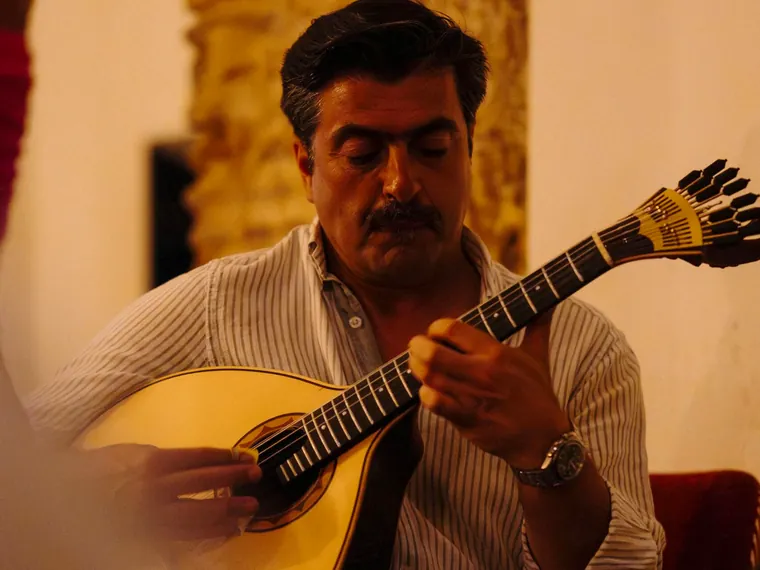
Portuguese guitar
Luís Guerreiro is one of today's leading names on the Portuguese guitar and one of the most recognised musicians of his generation. For more than two decades he has been part of Mariza's band, which he still accompanies on major stages in Portugal and abroad, carrying with him one of the most distinctive voices of the contemporary Portuguese guitar.
He started playing the Portuguese guitar at a young age and deepened his study of the instrument with the master António Parreira. In 2001 he gave his first solo concert at the Centro Cultural de Belém and, in 2003, he became a permanent member of Mariza's band.
Over a career shaped by many encounters and collaborations, he has accompanied some of the most important names in Portuguese music, among them Carlos do Carmo, Dulce Pontes, Camané, António Zambujo, Carminho, Kátia Guerreiro and Celeste Rodrigues, among many others.
Known for his virtuosity, his sensitivity and a deeply intuitive relationship with fado, Luís Guerreiro combines technical mastery of the Portuguese guitar with a way of playing in which every note serves the voice and the emotion.
At Fado ao Carmo, his presence stands for what we want to keep alive every night: artistic excellence, authenticity and the living tradition of Portuguese fado.
Days at Fado ao Carmo Alfama Monday, Tuesday, Wednesday, Thursday, Friday, Saturday, Sunday
×
CP Carlos Manuel Proença
Viola
Days at Fado ao Carmo Alfama Monday
×
FV Filipa Vieira
Fadista
Days at Fado ao Carmo Alfama Tuesday
×
João Domingos
Viola
João Domingos, born on 14 January 1998 in Lisbon, became interested in music at the age of 10, listening to and exploring many musical styles. At 16, encouraged by his cousin, the fadista Marco Rodrigues, to learn the fado viola, he fell in love with fado.
After two years teaching himself, he began studying classical guitar with José Carvalhinho and later also with Júlio Guerreiro.
He plays regularly in fado houses such as Fama de Alfama, Fado ao Carmo, Faia and Adega Machado, and has performed on many stages in Portugal and abroad with artists such as Sara Correia, Dulce Pontes, Raquel Tavares, Marco Rodrigues, Beatriz Felício and Tiago Correia, among others.
Days at Fado ao Carmo Alfama Tuesday
×
AM Ana Margarida
Fadista
Days at Fado ao Carmo Alfama Wednesday
×
JF João Filipe
Viola
Days at Fado ao Carmo Alfama Wednesday
×
Matilde Cid
Fadista
Matilde Cid was born in Lisbon and grew up in Estremoz. It was in Lisbon’s best fado houses that she found her artistic path.
In 2016 she took an important step in her career by filling the Centro Cultural de Belém with a solo concert. Since then she has taken fado to national and international stages and festivals, performing in countries such as England, Spain, France, Germany, Sweden, Poland, Romania, the Czech Republic, Morocco, Azerbaijan, Brazil and Kazakhstan.
She released Puro (2019), produced by Diogo Clemente and nominated for Best Fado Album at the PLAY Awards, and Desassossego (2023), an album on which she also wrote some of the lyrics and music. The British magazine Songlines described it as “balanced, eclectic and in extremely good taste”.
With a very personal and singular way of singing, Matilde Cid brings freshness and modernity to fado. On stage, her intimate and expressive interpretation creates a close, direct bond with the listener.
Days at Fado ao Carmo Alfama Thursday
×
Bernardo Saldanha
Viola
Bernardo Saldanha was born on 27 September 1995 in Almada but soon moved west, to Alcobaça, where he lived and studied music at the Academia de Música de Alcobaça until he was 18. He then came to Lisbon to study Communication Sciences at Universidade Nova.
His interest in fado came naturally from his family: his uncle, Mário Maduro, is a fado viola player and taught him to play and to love this style of music and of life.
Today he plays very regularly in fado houses and accompanies many fadistas and musicians on the fado viola, among them José Geadas, Sérgio 11, Soraia Cardoso, María Emília, Ana Margarida Prado, Matilde Cid, Cuca Roseta, Diana Vilarinho and Bernardo Couto. He also produced Ricardo Ribeiro's latest album, A alma só está bem onde não cabe.
Days at Fado ao Carmo Alfama Thursday
×
Sofia Ramos
Fadista
Sofia carries in her voice the old soul of fado and the freshness of the present. She honours the roots of tradition, reinventing it with identity and sensitivity.
In every interpretation she turns emotion into poetry. With a unique presence, she makes the past a bridge to the future of fado.
Days at Fado ao Carmo Alfama Friday
×
José Geadas
Fadista
José Geadas stands for continuity and authenticity in traditional fado. Born in Rio de Moinhos, in the municipality of Borba, he was drawn to fado from a very young age, first as a singer and later learning the Portuguese guitar, which he studied for three years at the Fado Museum with master António Parreira.
He won Lisbon’s Grande Noite do Fado in 2006 and has since sung on major stages in Portugal and abroad, from the CCB to Casa da Música, and in Lisbon’s most renowned fado houses. As a guitarist, he has accompanied fadistas such as Maria Emília and Bia Caboz.
At the end of 2023 he released his debut record, Outros Amores, true to the roots of traditional fado, and in 2024 he recorded the collective album Fados sem Fim, curated by Aldina Duarte. He is now preparing his second album.
Days at Fado ao Carmo Alfama Friday
×
PS Pedro Saltão
Viola
Days at Fado ao Carmo Alfama Friday
×
Diana Vilarinho
Fadista
Diana Vilarinho has been singing since she was 7 and, in 2008, won the Grande Noite do Fado, a milestone that confirmed her talent while she was still very young. With appearances on stages such as Santa Casa Alfama and tours around Europe, Diana divides her time between the theatres and the fado houses of Lisbon, where she keeps the authenticity of the genre alive.
After a debut album produced by Ricardo Ribeiro and a remarkable 2nd place at the 2025 Festival da Canção, Diana Vilarinho stands, between tradition and modernity, as one of the most consistent voices of her generation.
In 2026 she presents her most personal work to date, Uma Carta Escrita. The album is a letter to the future, deeply rooted in memory and in the search for freedom. This new record confirms Diana Vilarinho as one of the new voices of fado, joining tradition to a contemporary artistic direction. The album was presented in May at the Teatro da Trindade, in Lisbon.
Days at Fado ao Carmo Alfama Saturday
×
Francisco Moreira
Fadista
Francisco Moreira, aged 26, is one of the essential names of the new generation of fadistas.
A singer, musician, lyricist and composer born and raised in Vila do Conde, he began his artistic path at the age of 8, taking part in the TVI programme “Uma Canção para Ti” in 2009. In 2012 he won RTP’s “Grande Prémio Nacional de Fado”, and in 2018 he took part in “The Voice Portugal” on the same channel.
In Portugal he has performed on some of the most important stages, such as Casa da Música, Coliseu do Porto and CCB, and abroad in Canada, Macau, China, Poland, Romania, Lithuania, Spain and France.
He has released 4 albums, one of them nominated for an IPMA in 2020.
Days at Fado ao Carmo Alfama Saturday
×
Luís Pontes
Viola
Luís Pontes was born in 1964 into a family with a fado tradition. A computer engineer by profession and a musician by taste and vocation, he began playing the fado viola in 1978 with his teacher, Fernando Lima.
He has played with Anita Guerreiro, Maria Leopoldina da Guia and Fernando Maurício, among others.
He recorded on every one of Dulce Pontes' albums and toured the world with her for 12 years. He has also recorded with António Zambujo, Carla Pires, Arminda Alvernaz, Marco Rodrigues, Mafalda Arnauth and Carlos Leitão, among others.
Days at Fado ao Carmo Alfama Saturday
×
Ana Rita Prada
Fadista
Ana Rita Prada grew up in Trás-os-Montes and showed a talent for music from an early age, reaching the final of the programme Uma Canção Para Ti at 12. Alongside her studies at the conservatoire, where she learned piano and singing, she completed a master’s degree in Molecular Biology and Genetics.
At 19 she moved to Lisbon, where she established herself as a fadista in the traditional fado houses, and she has already performed in countries such as Spain, France, Switzerland, Poland and Kazakhstan. She currently sings in several fado houses in the capital and can be heard every Sunday at Fado ao Carmo.
Days at Fado ao Carmo Alfama Sunday
×
André Ramos
Viola
André Ramos was a fadista almost from birth. He inherited his love of fado from his closest family and started playing the viola and singing very early. He is one of the most sought-after viola players of his generation, also known as one of the resident faces of Mesa de Frades and Fado ao Carmo. He currently accompanies the fadistas Katia Guerreiro and Teresinha Landeiro, and has worked with great names in the history of fado such as Carminho, Cuca Roseta, Helder Moutinho and Ricardo Ribeiro.
Days at Fado ao Carmo Alfama Sunday