

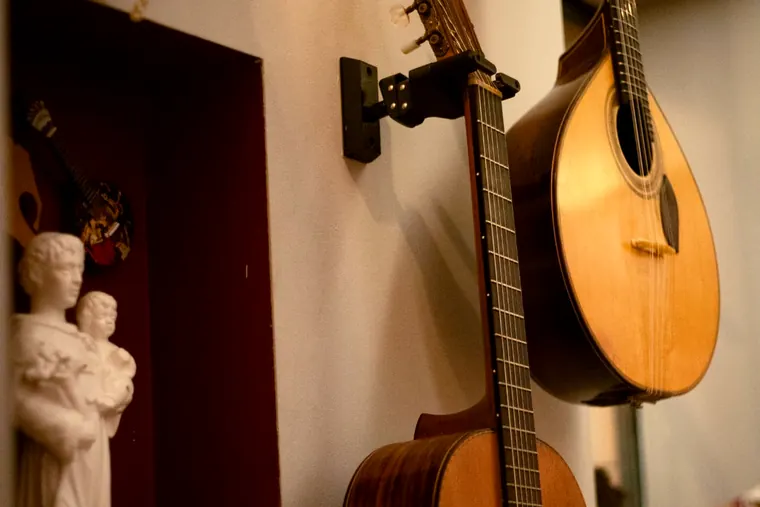
The first thing that happens in a fado house is silence. The lights go down, the conversations stop, and whoever was serving puts down what they are holding. Only then does the first note arrive.
The silence before
The phrase that marks the start of the singing, silêncio que se vai cantar o fado, has no documented author and no date. It settled in through use, and today it runs through every fado house in Lisbon.
The reason is practical before it is ceremonial. Fado is sung without heavy amplification, with one voice and two sets of strings. A conversation at a back table is audible at the front one and erases the Portuguese guitar, the most fragile instrument in the room.
Hence the small rooms. It is not a look: it is the only way for everyone to hear the same thing.
What is sung
A fado is a poem sung over a musical structure that already existed before it.
The traditional structures, called fados castiços, are fixed public-domain melodies, anonymous, passed on orally since nineteenth-century Lisbon. Any poem with the right metre can be sung over any of them. The same fado serves a sonnet by Camões and a text written last week.
The fadista picks the melody in the moment before singing, according to what is about to be said and to the state they are in. Which is why the same person does not sing the same evening twice.
Fado canção is a different thing. It arrived in the twentieth century, its melody is written for one set of words and no other, it is organised in verses and a refrain, and it leaves no room for improvisation. A good deal of what Amália recorded is fado canção.
The fados that have names
The three matrix structures have names and can be told apart by ear.
Fado Menor is in a minor key and moves slowly. Fado Corrido is major and very fast. Fado Mouraria is major and calmer, more lyrical. All three share the same harmonic alternation between tonic and dominant, which is the skeleton underneath everything.
From those derive dozens of fixed melodies, and some counts run to nearly two hundred.
A detail almost nobody knows: not every fado treated as traditional is anonymous. Alfredo Marceneiro, born Alfredo Rodrigo Duarte in 1891, composed Fado Cravo, Fado Bailado, Fado Laranjeira and Fado Louco, among others. He did not write music, and it was Armandinho who transcribed them for him. Because the fados came to be known by their first name rather than by their author, they entered the canon as if they had come from nowhere.
How it is played
A fado always has two instruments behind the voice: the viola and the Portuguese guitar. They do different jobs and they reached fado almost twenty years apart.
The oldest descriptions of Lisbon fado mention only the viola. Rui Vieira Nery shows that the sources of the period always name it. The viola was in the taverns from the start, and it was the viola people sang to.
The Portuguese guitar was somewhere else. Between the mid-eighteenth century and 1820 it was a drawing-room instrument, played in bourgeois and aristocratic circles to accompany modinhas. It had five pairs of strings, and the sixth pair was added in Portugal. Only after 1840 does it start appearing inside fado.
By the time it arrived, the groundwork was taken. The viola holds the harmony, the tempo and the bass, and whoever plays it spends the night without a single flourish. What was left was the space between the fadista's lines, and that is where the guitar settled. It comes in when the voice stops, answers it, and leaves when the voice returns.
Nobody decided it should work this way. It was the order in which the instruments arrived.
The Portuguese guitar
It does not come from the Spanish guitar. It descends from the Renaissance cittern, the instruments that travelled Europe long before fado existed.
Twelve steel strings in six pairs, on a pear-shaped body, tuned by a fan-shaped mechanism that holds the tension through a whole night. The Lisbon model is smaller and brighter, tuned to B, A, E, B, A, D. The Coimbra one has a larger body, tunes a tone lower, and behaves as a transposing instrument: they play a C and call it a D.
Where it came from, according to the research
Until the end of the eighteenth century there is not a single written Portuguese source in which the word fado carries a musical meaning.
The first known reference is from 1822, in a book by the Italian geographer Adriano Balbi published in Paris, listing fado among the most common dances of Brazil. In 1825 and 1826 the German officer Carl Schlichthorst writes from Rio de Janeiro that the favourite dance of the black population is called fado.
Only in the 1830s do fado houses and fadistas appear in Lisbon sources.
Nery traces fado's descent through the lundum and the modinha, with African and Brazilian influence. UNESCO adopted that reading: the 2011 inscription describes fado as a Portuguese multicultural synthesis of Afro-Brazilian sung dances, local traditional genres of song and dance, rural traditions brought by internal migration, and the cosmopolitan urban song patterns of the early nineteenth century.
The origins are still debated. Some argue for Moorish or maritime roots. The Afro-Brazilian account is the dominant one in the academy and it is the one in the official text.
Severa, and what actually survives of her
Maria Severa Onofriana was born on 26 July 1820 and died on 30 November 1846, at twenty-six, in Mouraria. Her last address was Rua do Capelão, number 35A, marked on the street today.
Almost everything told about her came later and is of contestable reliability, including the affair with the Count of Vimioso.
One correction is worth making, because the error is everywhere. Fadistas are said to wear a black shawl in mourning for Severa. No source supports it. The Fado Museum credits the convention to Amália Rodrigues: she established the systematic use of the black dress and shawl, and the habit of standing in front of the guitarists. It is a twentieth-century stage convention, not a nineteenth-century mourning.
Where to hear it in Lisbon
There are four neighbourhoods and it is not an accident. Mouraria, named by several researchers as the probable birthplace. Alfama, where the Fado Museum is. Madragoa, where Severa was born. And Bairro Alto, where fado houses multiplied above all from the 1930s.
The Fado Museum opened in 1998, in Largo do Chafariz de Dentro, in Alfama, housed in a nineteenth-century pumping station.
There is also fado vadio, amateur fado: no billing and no contract, and whoever sings invites themselves, with no agreed repertoire. It is practised in taverns and neighbourhood clubs, above all in Mouraria and Alfama.
The recognition
In 2011 UNESCO inscribed fado on the Representative List of the Intangible Cultural Heritage of Humanity, as Fado, urban popular song of Portugal. The decision is 6.COM 13.39, taken in Bali, and the file number is 00563.
The inscription describes transmission as informal tuition by older, respected exponents, often across generations of the same family.
Listening for the first time
Amália Rodrigues, 1920 to 1999, is the starting point. She made her professional debut in 1939, at Retiro da Severa. After her, Carlos do Carmo carried fado into concert halls and to audiences who had never set foot in a tavern.
Among those singing now: Mariza, Camané, Ana Moura, Carminho, Gisela João, António Zambujo. They sound nothing like one another.
You do not need the words. The voice and the guitar do nearly all the work, and the lyrics add a layer for those who have it.
We have two fado houses: Chiado, beside Largo do Carmo, and Alfama, on Travessa do Almargem, a few minutes from the Fado Museum. Tables can be booked here.