

Fado ao Carmo has two fado houses in Lisbon, in different neighbourhoods. They do not suit the same evening. This piece sets out what changes between them, with the hours, the sizes and the prices up front.
Chiado
Rua da Condessa, 52, a few steps from Largo do Carmo and the ruins of the Carmo Convent, which came down in the 1755 earthquake and has stood roofless ever since.
The room is 50 square metres and seats between 38 and 40 people. It opens at 19:00 and closes at 01:00. The fado starts at 20:30.
You eat petiscos à la carte, with a minimum spend of 40 euros per person. That amount is fully deductible against food and drink, which means it is not a cover charge: it is what you spend at the table.
This is the fado house where we give the stage to younger fadistas and to voices that are starting out.
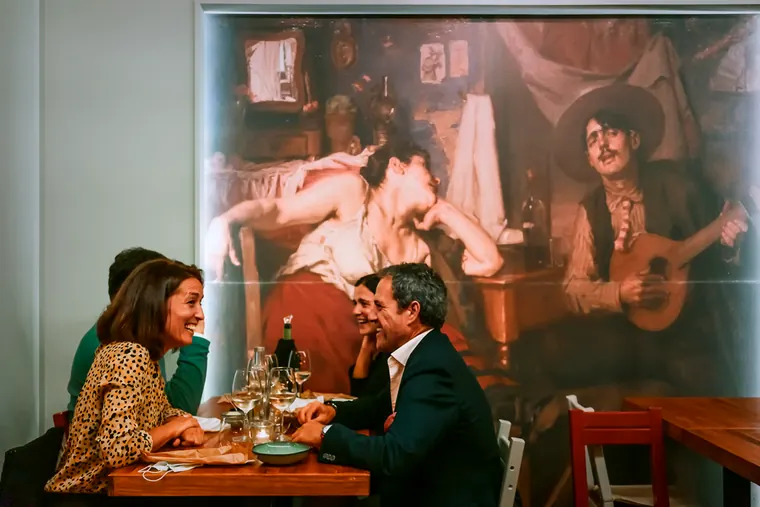
On the wall hangs a reproduction of O Fado, by José Malhoa, painted in 1910. The original is in the Fado Museum, in Alfama.
Alfama
Travessa do Almargem, 1B, in the oldest neighbourhood in the city and a few minutes from the Fado Museum.
The room is 150 square metres, three times the size of Chiado, and seats between 60 and 65. Bare stone, vaulted ceilings, and a stage visible from every seat. It opens at 19:30 and closes at 02:00. The fado starts at 21:00.
The evening is a full dinner, with a menu by Chef António Saraiva. It is 65 euros per person for the Dinner and Fado menu, with a 35 euro per person pre-authorisation at booking.
This is also the fado house of Noites do Carmo, the series where we close the room for an invited guest. Mariza, António Zambujo and Milhanas have all sung there, the last of them on the same night that pastry chef Francisco Siopa signed the sweet half of the menu.
The neighbourhoods are not a detail
Fado was born in the neighbourhoods by the river, in the first half of the nineteenth century. Alfama and Mouraria are in every early description. Anyone dining in Alfama is dining one street from where this started.
Alfama has a peculiarity that explains how it is built: it survived the 1755 earthquake almost intact, sitting on solid rock while much of the lower city sat on soft ground and came apart. That is why the streets are still narrow and crooked, on their pre-earthquake plan, and why the rooms are vaulted and built of bare stone.
The Fado Museum is in Largo do Chafariz de Dentro, a few minutes from our door, and it is where Malhoa's O Fado hangs today.
Chiado is a different Lisbon. It was rebuilt after 1755 on the Pombaline plan and became the neighbourhood of cafés, bookshops and newspapers, where the city met to argue. In 1988 a fire destroyed part of it, and the rebuilding was given to Álvaro Siza Vieira.
Largo do Carmo, at our door, is where the Estado Novo government surrendered on 25 April 1974, inside the Carmo barracks. The ruins of the Carmo Convent beside it have stood roofless since the earthquake, and were deliberately left that way.
Two different histories of the same city, fifteen minutes' walk apart.
Who sings
Both fado houses have fado every night and the accompaniment is the same in both: viola and Portuguese guitar. The viola holds the harmony and the tempo, the guitar comes into the space between the fadista's lines.
What changes is who is on the floor. In Chiado we give room to younger fadistas and to voices still building a repertoire. In Alfama, alongside the house singers, there are the Noites do Carmo, when the room closes for an invited guest.
The Portuguese guitar heard in both is the Lisbon model, smaller and brighter than the Coimbra one, tuned to B, A, E, B, A, D.
How to choose
By the hour. To eat early and hear fado before nine, Chiado. To sit down at half past nine and leave after midnight, Alfama.
By appetite. Petiscos à la carte, chosen one at a time through the evening, is Chiado. A full dinner menu served at the table is Alfama.
By group size. Up to 40 people fit in Chiado. Above that, and up to 65, it has to be Alfama.
By budget. 40 euros per person in Chiado, deductible against food and drink. 65 euros per person in Alfama, menu included.
What does not change
There is live fado every night in both fado houses. In both, silence is asked for while anyone is singing, for the same technical reason: without heavy amplification, a conversation at a back table is audible at the front one.
And in both the accompaniment is the same, viola and Portuguese guitar, as it has been since the guitar entered fado after 1840.
See both fado houses: Chiado and Alfama. Tables can be booked here.